La Caravana del Diablo, 2020
La Caravana del Diablo began with a simple but urgent act: refusing to look away. For years, I have followed migrants from Central America as they moved north through Guatemala and Mexico toward the U.S. border, listening to their stories and witnessing what happens when survival itself becomes a crime. This work emerged from walking beside people whose lives had already been torn apart by violence, poverty, and displacement, and who were then forced to confront one more storm on the road north: the storm of indifference. Public presentations of this series have traced that reality through the 2020 Honduran caravan, when migrants were met at the Mexican border with tear gas, detention, and forced return instead of refuge. Today, under Trump’s second presidency, that storm has not passed. It has been formalized. Since January 2025, the U.S. government has declared an “invasion” at the southern border, sought to suspend entry, shut down CBP One appointments, terminated major parole pathways, and suspended refugee admissions. The administration has celebrated record-low encounter numbers as a victory, while courts have had to intervene against some of its broadest attempts to erase asylum protections, and detention has continued to expand. What has changed is not the desperation that drives migration, but the scale of the machinery built to hide it, contain it, and criminalize it. The reasons people move remain painfully consistent. Across North Central America, migration continues to be shaped by the convergence of economic precarity, violence, and climate-related disaster. In Honduras and across the Dry Corridor, prolonged drought, food insecurity, environmental shocks, and social instability continue to unsettle daily life. Globally, forced displacement has reached 123.2 million people, and since 2014, more than 83,000 migrants have been recorded dead or missing worldwide. The U.S.-Mexico border remains one of the most lethal corridors in the Americas. La Caravana del Diablo is therefore not only about one caravan, one border, or one administration. It is about the human cost of a world organized around fear. These photographs insist on seeing migrants not as a threat, a statistic, or a political talking point, but as people carrying memory, grief, courage, and hope. If there is a storm at the center of this work, it is not only the storm of displacement. It is the storm created when cruelty becomes policy and compassion is treated as weakness. Against that storm, the act of witnessing becomes its own form of resistance
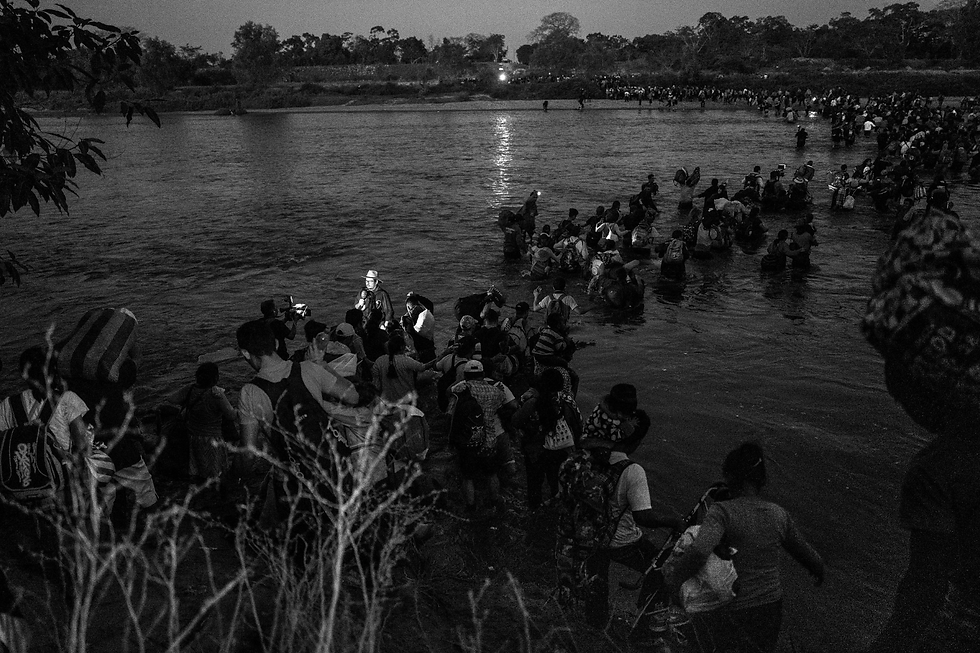
Archival Pigment Print on Paper 16 x 24 in / Ed. 5 + AP + EC 26 x 40 in / Ed. 5 + AP + EC

16 x 24 in / Ed. 5 + AP + EC 26 x 40 in / Ed. 5 + AP + EC

Archival Pigment Print on Paper 16 x 24 in / Ed. 5 + AP + EC 26 x 40 in / Ed. 5 + AP + EC
Archival Pigment Print on Paper 16 x 24 in / Ed. 5 + AP + EC 26 x 40 in / Ed. 5 + AP + EC
La Bestia
La Bestia is the name commonly given to the freight train routes that cut across Mexico, carrying commercial cargo north. For decades, those same trains have also become one of the most dangerous corridors used by migrants and people seeking refuge as they move through the country. This project looks at that contradiction directly: a transportation system built for goods that has also become a precarious passage for human beings displaced by violence, poverty, political instability, and climate-related collapse. Private cargo companies, including Ferromex and CPKC de México, operate Mexico’s freight rail network. It remains a vital artery for trade even as people in transit continue to board its moving cars in search of a way forward. For the people who ride it, La Bestia is not simply a route but a landscape of exposure. Along the journey, migrants and asylum seekers are routinely vulnerable to kidnapping, robbery, extortion, sexual violence, injury, disappearance, and death. Many travel without money for formal transportation, without access to safe legal pathways, and without certainty that the next state checkpoint, criminal group, or stretch of track will let them continue. Yet the route is also sustained by another reality: shelters, kitchens, and volunteer networks that offer food, medical care, legal orientation, and temporary refuge to people whom official systems often fail. Since Donald Trump returned to office on January 20, 2025, the political meaning of this journey has shifted again. His administration canceled CBP One border appointments, promoted CBP Home as a tool for “self-deportation,” and attempted to suspend asylum access at the southern border through a presidential proclamation. Although federal courts later ruled that the effort was unlawful, the policy shock reshaped movement across the region: northbound migration fell sharply, southbound return flows increased, and Mexico’s role as both a transit corridor and a place of refuge grew even more pronounced. Today, La Bestia stands not only as a symbol of migration but as an index of a broader border regime in which mobility is criminalized, protection is narrowed, and survival depends on improvisation, endurance, and solidarity.

Archival Pigment Print on Paper 16 x 24 in Ed. 10 + AP + EC

Archival Pigment Print on Paper 16 x 24 in Ed. 10 + AP + EC

Archival Pigment Print on Paper 16 x 24 in Ed. 10 + AP + EC
Archival Pigment Print on Paper 16 x 24 in Ed. 10 + AP + EC
La Caravana del Diablo, 2018

Archival Pigment Print on Paper 16 x 24 in / Ed. 5 + AP + EC 26 x 40 in / Ed. 5 + AP + EC

Archival Pigment Print on Paper 16 x 24 in / Ed. 5 + AP + EC 26 x 40 in / Ed. 5 + AP + EC

Archival Pigment Print on Paper 16 x 24 in / Ed. 5 + AP + EC 26 x 40 in / Ed. 5 + AP + EC
Archival Pigment Print on Paper 16 x 24 in / Ed. 5 + AP + EC 26 x 40 in / Ed. 5 + AP + EC